

Weight-loss medications like Ozempic and Mounjaro have fundamentally changed how we talk about health. For millions, the scale is finally moving in ways that once felt completely impossible.
It’s an incredible medical breakthrough, and the excitement is entirely justified.
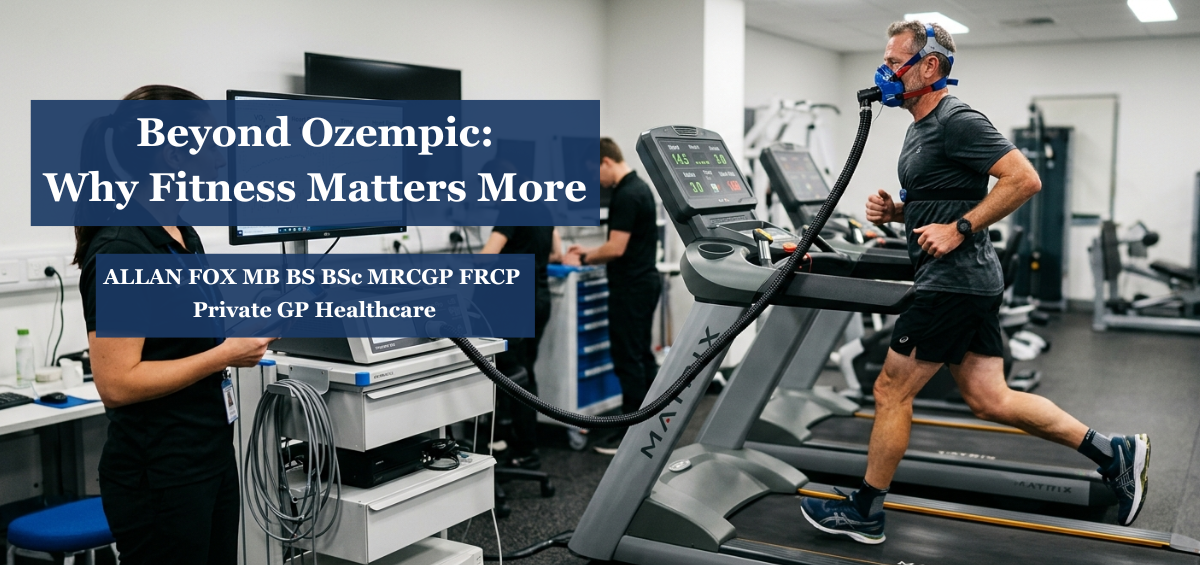
But while everyone is celebrating the dropped pounds, we’re missing a massive piece of the puzzle. There is a hidden health metric that predicts how long, and how well, you will live far better than your weight ever could. It’s called VO₂ Max, and it represents your internal fitness engine.
A look at recent medical data reveals a crucial catch with these new medications: they are highly effective at reducing weight, but they don’t automatically make you fit. In fact, up to 40% of the weight lost on these drugs can come from lean muscle mass rather than fat.1
When researchers looked at long-term survival data, the conclusion was striking: fitness matters more than weight. A person’s cardiorespiratory fitness is a far more accurate predictor of their lifespan than whether they are technically classified as overweight. Once you factor physical fitness into the equation, body weight alone stops predicting your risk of death entirely.2
Losing weight is a great start, but upgrading your internal fitness engine is what actually protects your life.
What Exactly is Your Internal Fitness Engine?
Think of VO₂ max as a measure of how efficiently your heart and lungs can pump oxygen to your muscles when you’re pushing yourself. It is the ultimate benchmark of your aerobic capacity.
You don’t need to become a marathon runner to reap the rewards. Moving your fitness score from “poor” to just “fair” cuts your risk of death by around 50%.3 Every small improvement you make gives you a 13% to 15% boost in longevity protection.4 To put it simply: a low fitness capacity makes a normal walk feel tiring, while a healthy score allows you to stride uphill comfortably. You don’t need to be an elite athlete; you just need to keep your body from becoming out of shape.
The Ultimate Brain Insurance
Building up this fitness reserve does just as much for your mind as it does for your heart.
Long-term health tracking shows that highly fit individuals cut their risk of developing dementia in half compared to those who are inactive.5 Furthermore, women who maintain a high level of fitness in midlife delay the onset of dementia by an average of nearly a decade.6
Neurological research shows that higher cardiorespiratory fitness acts like insulation for your brain’s wiring, protecting the vital pathways that naturally degrade as we get older.7
Remarkably, it even helps preserve sharp memory and cognitive function in people who are genetically predisposed to Alzheimer’s disease.8
The Roadmap to Boosting Your Engine
If you want to protect your brain and upgrade your fitness, your weekly routine needs a mix of two distinct styles of movement:
Steady, Conversational Cardio: This is your foundation. Think of activities like a brisk walk, a light jog, or an easy bike ride where you can comfortably carry on a conversation but couldn’t easily sing a song. Aim for 3 to 4 sessions a week, lasting about 45 to 60 minutes each.
Short, High-Effort Intervals: Once or twice a week, push your heart rate up high. A highly effective method is the “4×4 interval” – 4 minutes of hard effort (like a fast uphill walk or cycling sprint) followed by 4 minutes of easy recovery, repeated 4 times.
Studies show that even older adults can boost their cardiorespiratory fitness by 10% in just two months using this protocol.9
Without deliberate exercise, your aerobic capacity naturally drops by about 10% every decade after you turn 30. Regular, consistent movement cuts that decline right in half.10
Ditch the Smartwatch Stress
When it comes to tracking your progress, don’t rely too heavily on the fitness score on your smartwatch. Recent studies show that popular wearable devices tend to underestimate your true capacity by a significant margin, which can completely misrepresent your actual health category.11
Instead of stressing over daily tech data, watch your real-world performance. If you can walk up a local hill faster, or power through a workout with less fatigue than you did three months ago, your engine is getting stronger – no matter what your watch says.
The Bottom Line
None of this is to say that weight-loss medications aren’t valuable. Dropping extra weight does wonders for reducing joint pain, lowering chronic inflammation, and taking a massive burden off your cardiovascular system.
However, losing weight while allowing your actual physical fitness to stall out means you are leaving the most vital health benefits on the table. If you are using tools like Ozempic, remember that the medication only handles the scale. It takes regular, intentional movement to handle everything else.
Derived from an article from Forever Young substack
- A Circulation primer on GLP-1 receptor agonists and muscle mass notes that semaglutide has been associated with lean mass loss of up to 40% of total weight loss, based on data from the STEP 1 trial. Hammoud R, et al. Muscle Mass and Glucagon-Like Peptide-1 Receptor Agonists: Adaptive or Maladaptive Response to Weight Loss? Circulation, 2024. https://www.ahajournals.org/doi/10.1161/CIRCULATIONAHA.124.067676. See also Neeland IJ, et al. Changes in lean body mass with glucagon-like peptide-1-based therapies. Diabetes, Obesity and Metabolism, 2024. https://dom-pubs.onlinelibrary.wiley.com/doi/10.1111/dom.15728 [↩]
- A meta-analysis by Barry et al found that when cardiorespiratory fitness (CRF) is accounted for, the mortality risk associated with high BMI is either eliminated or greatly attenuated depending on the study. Cited in McAuley PA, et al. Obesity treatment: Weight loss versus increasing fitness and physical activity for reducing health risks. PMC, 2021. https://pmc.ncbi.nlm.nih.gov/articles/PMC8560549/. [↩]
- A study of over 122,000 patients, where raw death rates were 23.7% in the “low” fitness category versus 10.6% in the “below average” category, a difference of roughly 50%. Mandsager K, et al. Association of Cardiorespiratory Fitness With Long-term Mortality Among Adults Undergoing Exercise Treadmill Testing. JAMA Network Open, 2018. https://pmc.ncbi.nlm.nih.gov/articles/PMC6324439/. [↩]
- Kodama S, et al. found that each 1-MET increment in cardiorespiratory fitness was associated with a 13% and 15% risk reduction in all-cause mortality. Cited in Kaminsky LA, et al. Mortality trends in the general population: the importance of cardiorespiratory fitness. PMC, 2010. https://pmc.ncbi.nlm.nih.gov/articles/PMC2951585/ [↩]
- A 26.5 year Finnish cohort study found that subjects with cardiorespiratory fitness above 9 METs had a 53% decreased risk of incident dementia compared to those below 6 METs. Kurl S, et al. Cardiorespiratory fitness and risk of dementia: a longitudinal cohort study. Alzheimer’s & Dementia: Diagnosis, Assessment & Disease Monitoring, 2026. https://alz-journals.onlinelibrary.wiley.com/doi/10.1002/dad2.70326 [↩]
- A 44 year Swedish study of women found high midlife cardiovascular fitness delayed age at dementia onset by 9.5 years compared to medium fitness. Hörder H, et al. Midlife cardiovascular fitness and dementia: A 44-year longitudinal population study in women. Neurology, 2018. https://www.ncbi.nlm.nih.gov/pmc/articles/PMC5894933/. [↩]
- A PNAS study found an association between higher cardiorespiratory fitness and higher cerebral myelination, the fatty insulating layer around nerve fibres, in ageing adults. https://www.pnas.org/doi/10.1073/pnas.2402813121. [↩]
- A study of adults at risk for Alzheimer’s disease found higher cardiorespiratory fitness was associated with slower decline in grey matter volume and cognitive function, with the effect appearing stronger among carriers of the APOE epsilon4 gene variant linked to Alzheimer’s risk. Dougherty RJ, et al. Cardiorespiratory fitness mitigates brain atrophy and cognitive decline in adults at risk for Alzheimer’s disease. Alzheimer’s & Dementia: Diagnosis, Assessment & Disease Monitoring, 2021. https://pmc.ncbi.nlm.nih.gov/articles/PMC8274307/ [↩]
- An 8 week high-intensity interval training study in healthy elderly subjects (mean age 68) found a 9% increase in VO2max. Bruseghini P, et al. Effects of eight weeks of aerobic interval training and of isoinertial resistance training on risk factors of cardiometabolic diseases and exercise capacity in healthy elderly subjects. Oncotarget, 2015. https://www.ncbi.nlm.nih.gov/pmc/articles/PMC4627287/. [↩]
- A 10% per decade decline is generally accepted in the literature. Ozemek C, et al. Age-related decline in peak oxygen uptake: Cross-sectional vs. longitudinal findings. A review. PMC, 2023. https://pmc.ncbi.nlm.nih.gov/articles/PMC9975246/. On the effect of continued training, a longitudinal study of master athletes versus sedentary men found sedentary men’s VO2max declined 12% per decade, while master athletes who kept training declined only 5.5% per decade, describing this as approximately half the rate of decline. Pollock ML, et al. Decline in VO2max with aging in master athletes and sedentary men. Journal of Applied Physiology, 1987. https://pubmed.ncbi.nlm.nih.gov/2361923/ [↩]
- A validation study found the Apple Watch Series 7 underestimated VO2max compared to gold standard laboratory testing, with this underestimation more pronounced in participants with high fitness levels. Assessing the Accuracy of Smartwatch-Based Estimation of Maximum Oxygen Uptake Using the Apple Watch Series 7. JMIR Biomedical Engineering, 2024. https://biomedeng.jmir.org/2024/1/e59459. A separate validation study found a similar underestimation of about 6 ml/kg/min on average. PMC, 2025. https://www.ncbi.nlm.nih.gov/pmc/articles/PMC12080799/. [↩]

Recent Comments