

Call us: 01233 885257
privategphealthcare@gmail.com
Private GP HealthcarePrivate GP HealthcarePrivate GP HealthcarePrivate GP Healthcare
  • HOME
  • ABOUT
    • The Private GP Healthcare Team
    • Testimonials
  • PRIVATE GP
    • What can a Private GP offer you?
  • SERVICES
    • Genetic Testing
    • Health Screening
  • PATIENT INFORMATION
    • Registration & Membership
    • Terms and Conditions
    • Confidentiality and Data Protection
    • Complaints Procedure
  • CONTACT US
  • FEES
  • BLOG
Previous

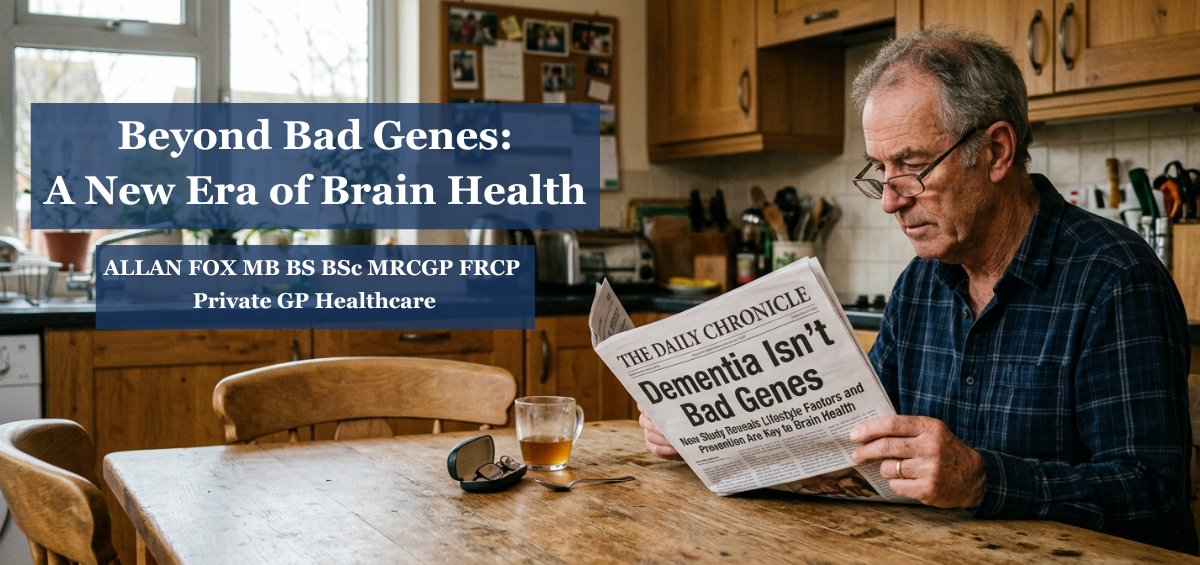
Dementia Isn’t the Sentence It Used to Be: A New Era of Hope

By Allan Fox | Healthy Lifestyle, Longevity | Comments are Closed | 16 July, 2026 | 0

For decades, a dementia diagnosis felt like an unavoidable twist of fate. The common belief was simple: if you had “bad genes,” bad luck, or developed specific plaques in your brain, there wasn’t much anyone could do about it.

But medicine is evolving, and the new picture of brain health is far more hopeful. Today, researchers are shifting away from seeing dementia as a sudden, unstoppable disease. Instead, they view it as a “slow-cooked” condition—one that builds quietly over decades and is shaped by everyday factors we actually have the power to change. In fact, a recent Lancet Commission finding suggested that close to half of dementia cases worldwide could be prevented or delayed.1

Newer 2025 data pushes that number even higher, suggesting up to 65% of cases might be preventable.2

Here is a look at how the science has shifted, and what it means for your everyday brain health.

The Old Story

For a long time, the dominant theory surrounding Alzheimer’s disease (the most common form of dementia) was something called the “amyloid cascade hypothesis“.

Here is how that old story went:

  • The Culprit: Sticky proteins called amyloid plaques build up in the brain.
  • The Effect: These plaques kill neurons, leading directly to memory loss and cognitive decline.
  • The Treatment: Billions of dollars were poured into developing drugs designed to clear these plaques away.

A Widened Lens on Brain Health

While this theory isn’t entirely wrong, scientists have realised it is incomplete. For starters, many older adults walk around with substantial plaque buildup in their brains but maintain perfectly sharp, healthy minds.3

Furthermore, while a new generation of plaque-clearing drugs (like Lecanemab and Donanemab) successfully remove these plaques, they only modestly slow down mental decline – and they come with real side effects.4

Because of this, researchers have widened their lens. Instead of looking at Alzheimer’s as a single villain, they now view it more like a long traffic jam. Amyloid plaques are just one car in the pile-up. Other contributing factors include:

  • Tau tangles (another type of misfolded protein)
  • Chronic inflammation
  • Leaky blood vessels in the brain
  • Struggling mitochondria (the energy powerhouses of our cells)
  • Disrupted sleep

Different types of dementia—such as vascular dementia, Lewy body dementia, and frontotemporal dementia – each have their own unique mix of these factors. The key takeaway? No single factor is doing all the damage on its own.

A Life-Course Condition

Because dementia develops over a lifetime rather than overnight, we have an incredible opportunity to intervene early. Brain health is shaped by dozens of everyday factors we can actively influence, including:

  • Blood pressure
  • Hearing health
  • Sleep quality
  • Education
  • Social connections (loneliness)
  • Air quality
  • Not smoking
  • Managing your weight to avoid obesity
  • Treating depression seriously
  • Staying active
  • Keeping diabetes well controlled
  • Drinking alcohol in moderation
  • Avoiding head injury
  • Keeping cholesterol in the normal range
  • Getting your vision checked regularly
  • And finally a new addition: get the Shingrix vaccine given recent evidence for a marked reduction in dementia following the vaccine5

By taking care of our bodies, staying socially active, and managing chronic conditions today, we are actively protecting our minds for tomorrow.

What is one small change you are focusing on this week to keep your brain healthy and active?

Derived from an article by Forever Young on Substack

  1. Livingston G, Huntley J, Liu KY, et al. Dementia prevention, intervention, and care: 2024 report of the Lancet standing Commission. Lancet. 2024;404(10452):572-628. https://pubmed.ncbi.nlm.nih.gov/39096926/ [↩]
  2. Mostert CM. Reassessing dementia risk: expanding the 2024 Lancet Commission report for a more accurate global understanding. Alzheimers Dement. 2025. https://www.ncbi.nlm.nih.gov/pmc/articles/PMC12739491/ [↩]
  3. Jansen WJ, Ossenkoppele R, Knol DL, et al. Prevalence of cerebral amyloid pathology in persons without dementia: a meta-analysis. JAMA. 2015;313(19):1924-1938. https://www.ncbi.nlm.nih.gov/pmc/articles/PMC4486209/ [↩]
  4. Jin M, Noble JM. What’s in it for me? Contextualizing the potential clinical impacts of Lecanemab, Donanemab, and other anti-beta-amyloid monoclonal antibodies in early Alzheimer’s disease. eNeuro. 2024;11(9):ENEURO.0088-24.2024. https://pmc.ncbi.nlm.nih.gov/articles/PMC11439562/ [↩]
  5. Taquet M, Dercon Q, Todd JA, Harrison PJ. The recombinant shingles vaccine is associated with lower risk of dementia. Nat Med. 2024;30(10):2777-2781. https://pubmed.ncbi.nlm.nih.gov/39053634/ [↩]

No tags.

Allan Fox

Dr Allan Fox MB BS BSc MRCGP FRCP became a GP in 1994, when he joined Wye Surgery and has continued to pursue his interest in Cardiology, managing referrals from both his own practice and other practices. In 2004 he became a GP Trainer and latterly a GP Programme Director, responsible for the training of local GP's. He recently stood down from this role but remains a GP Appraiser. He was also made a Fellow of the Royal College of Physicians in 2004, an honour awarded by his peers for an outstanding contribution to medicine and training of hospital doctors.

More posts by Allan Fox

Related Post

  • How do we make a diagnosis?

    By Allanfox | Comments are Closed

    How does one make a diagnosis? Diagnosis is a fascinating area. As anyone who searches Google with a symptom finds (most of us at some time or another), a single symptom can represent anything fromRead more

  • Avoiding Medical Errors

    By Allanfox | Comments are Closed

        I have been reading Matthew Syed’ fabulous book Black Box Thinking. I think it should be on the reading list of all decision makers but especially, clinicians, medical politicians and most of allRead more

  • How Can We Encourage Children To Take Their Tablets?

    By Allan Fox | Comments are Closed

    How can we encourage children to take their tablets? Many medicines used in paediatric medicine only come in tablet form. This can cause enormous problems in getting some children to take medication. Crushing tablets oftenRead more

  • A Virtual Day at the Seaside

    By Allanfox | Comments are Closed

    A Virtual trip to the beach I sounds bizarre does it not? It is something else I found on the fabnhsstuff website and it resonated with an idea I had some years ago. My planRead more

  • Marginal Gains

    By Allan Fox | Comments are Closed

    Marginal gains I love Dave Brailsford, now Sir DB’s, idea of marginal gains. With British Cycling he took every aspect of cycling from biomechanics to diet to helmets and broke them down to their componentRead more

  • Fredas fall, a Falls Prevention Video

    By Allanfox | Comments are Closed

    Freda’s Fall is an interactive e-learning film focused on the prevention and management of falls. It has been funded by Health Education England North West London, as part of development of a Community Education ProviderRead more

  • Medical Apps

    By Allanfox | Comments are Closed

    I am not sure I entirely have my head around this. I understand apps of course. I certainly use medical apps to calculate certain scores like CHADSVasc2, HASBLED, Wells scoring and the like. But thereRead more

  • Self Help Forum

    By Allanfox | Comments are Closed

    The Self-Help Forum   This is one of the best ideas I have seen for some time.   http://www.selfcareforum.org/   It is a gold mine of advice, covering;   Common conditions with excellent fact sheetsRead more

Previous

Recent Posts

  • Dementia Isn’t the Sentence It Used to Be: A New Era of Hope
  • The Missing Half of the Weight Loss Miracle: Why the Scales are not the Whole Story in longevity and dementia risk
  • Six essential blood tests for longevity and a kettlebell routine shown to improve the markers associated with longevity.
  • Falling Can Be More Dangerous Than Cancer
  • The Bone Drug That Might Secretly Be A Fountain of Youth

Recent Comments

    Archives

    • July 2026
    • March 2026
    • September 2024
    • October 2023
    • September 2023
    • April 2021
    • January 2021
    • December 2020
    • June 2020
    • April 2020
    • November 2019
    • August 2019
    • July 2019
    • June 2019
    • April 2019
    • January 2019
    • October 2018
    • September 2018
    • May 2018
    • February 2018
    • January 2017
    • November 2016
    • October 2016
    • September 2016
    • August 2016

    Categories

    • Blood Pressure
    • Bowels
    • Cancer
    • Covid-19
    • Dementia
    • Diabetes
    • Genetic Testing
    • Healthy Lifestyle
    • Longevity
    • Mens' Health
    • Pharmaceuticals
    • Private Healthcare Benefits
    • Uncategorized
    • Vaccines
    • Womens-Health
    Copyright 2015-2026 PRIVATE GP HEALTHCARE LLP. All Rights Reserved.
    • HOME
    • ABOUT
      • The Private GP Healthcare Team
      • Testimonials
    • PRIVATE GP
      • What can a Private GP offer you?
    • SERVICES
      • Genetic Testing
      • Health Screening
    • PATIENT INFORMATION
      • Registration & Membership
      • Terms and Conditions
      • Confidentiality and Data Protection
      • Complaints Procedure
    • CONTACT US
    • FEES
    • BLOG
    Private GP Healthcare