

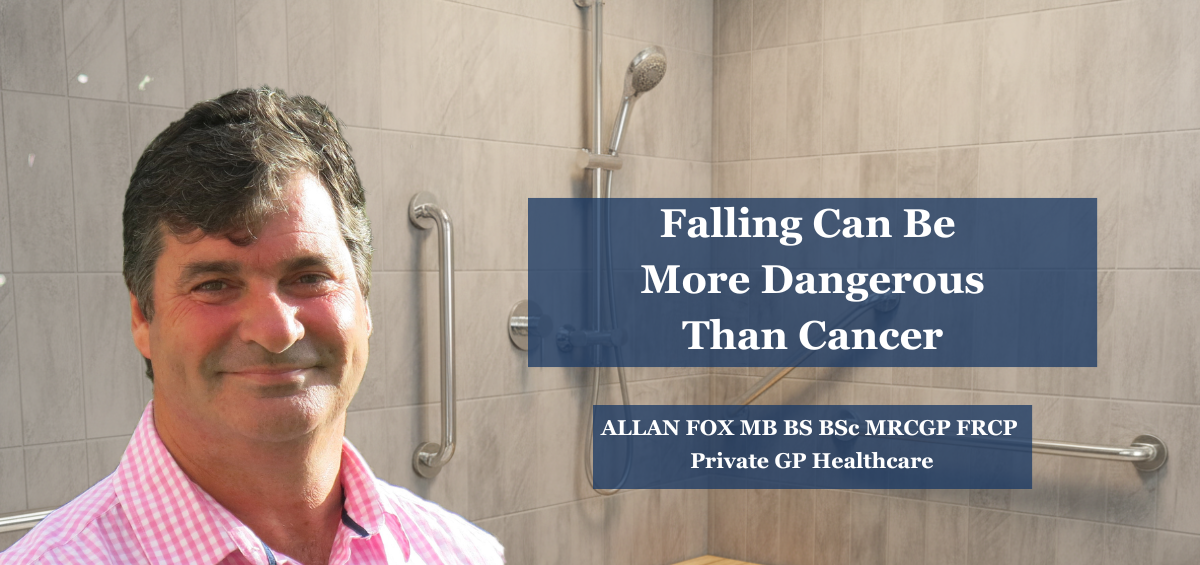
We spend billions on the “longevity revolution”—epigenetic clocks, “fountain of youth” pills, and AI diagnostics. But while we’re looking for the future of medicine, a quiet killer is hiding in plain sight. Specifically, it’s hiding in your bathroom and on your staircase.
If you’re over 65, a fall isn’t just an “oops” moment. It is often more dangerous than a cancer diagnosis.
The Mathematics of a Stumble
Here is a sobering reality: The American Cancer Society reports a five-year survival rate of 70% for all cancers combined.¹ Now, look at a hip fracture in an older adult. Research shows a three-year mortality rate of 60%.²
Physicians often describe the aftermath of a fall as “comparable to advanced malignancies.”³ It isn’t the fall itself that typically kills you; it’s the cascade—the surgery, the immobility, the muscle loss, and the susceptibility to pneumonia and blood clots.⁴
Why don’t 25 year olds die from slipping?
Why don’t 25-year-olds die from slipping on a wet floor? Their nervous system is running a high-speed stabilisation program. When they slip, their body reacts in about 100 milliseconds.⁵
As we age, that “program” slows down. A delay of just 14 milliseconds in muscle activation—the blink of an eye—is the difference between regaining your balance and a catastrophic impact.⁶ Add in sarcopenia (muscle loss) and thinned bones, and the floor becomes the most dangerous surface in your life.⁷
How We Can Prevent This:
Falling isn’t a sign of “weakness”; it’s a matter of physics and neurology. You can’t stop the clock, but you can change the environment and the “hardware.”
1. The 10-Minute Home Audit
The Bathroom: This is the highest-risk zone. Grab bars (real ones, not towel racks) are the “seatbelts” of the home.⁸
The Lighting: Many falls happen during 3 a.m. bathroom trips. Install high-quality nightlights.⁹
The Rugs: If a rug isn’t taped down, it’s a trap. Remove it.⁸
2. Train Your “Internal GPS”
Tai Chi has been shown to reduce fall risk by up to 55% in some studies.¹⁰ It’s essentially “software updates” for your balance. Pair it with resistance training to keep the “cushion” of your muscles strong.¹¹
The Bottom Line
A grab bar costs £30. A hip fracture can cost you your independence. Don’t let vanity get in the way of a long life.
Derived from the excellent Forever Young Substack
Dr Allan Fox, Private GP Healthcare in Canterbury.
Footnotes (for your reference)
1. American Cancer Society. Cancer Facts & Statistics. (5-year survival ~70% across all cancers combined)
2. Haentjens P et al. Meta-analysis: Excess mortality after hip fracture. Ann Intern Med. 2010.
3. LeBlanc KE et al. Hip fracture: diagnosis, treatment, and secondary prevention. Am Fam Physician. 2014.
4. Roche JJW et al. Effect of comorbidities and postoperative complications on mortality after hip fracture. BMJ. 2005.
5. Maki BE, McIlroy WE. Control of rapid limb movements for balance recovery. Age and Ageing / J Gerontol literature.
6. Pijnappels M et al. Identification of elderly fallers by muscle strength and reaction time. J Biomech. 2008.
7. Cruz-Jentoft AJ et al. Sarcopenia: revised European consensus. Age and Ageing. 2019.
8. CDC / NICE fall prevention guidelines (home hazard modification)
9. Stevens JA et al. Circumstances and outcomes of falls among older adults. CDC data
10. Sherrington C et al. Exercise for preventing falls in older people. Cochrane Review, 2019.
11. Liu-Ambrose T et al. Resistance training and fall prevention. J Am Geriatr Soc.

Recent Comments